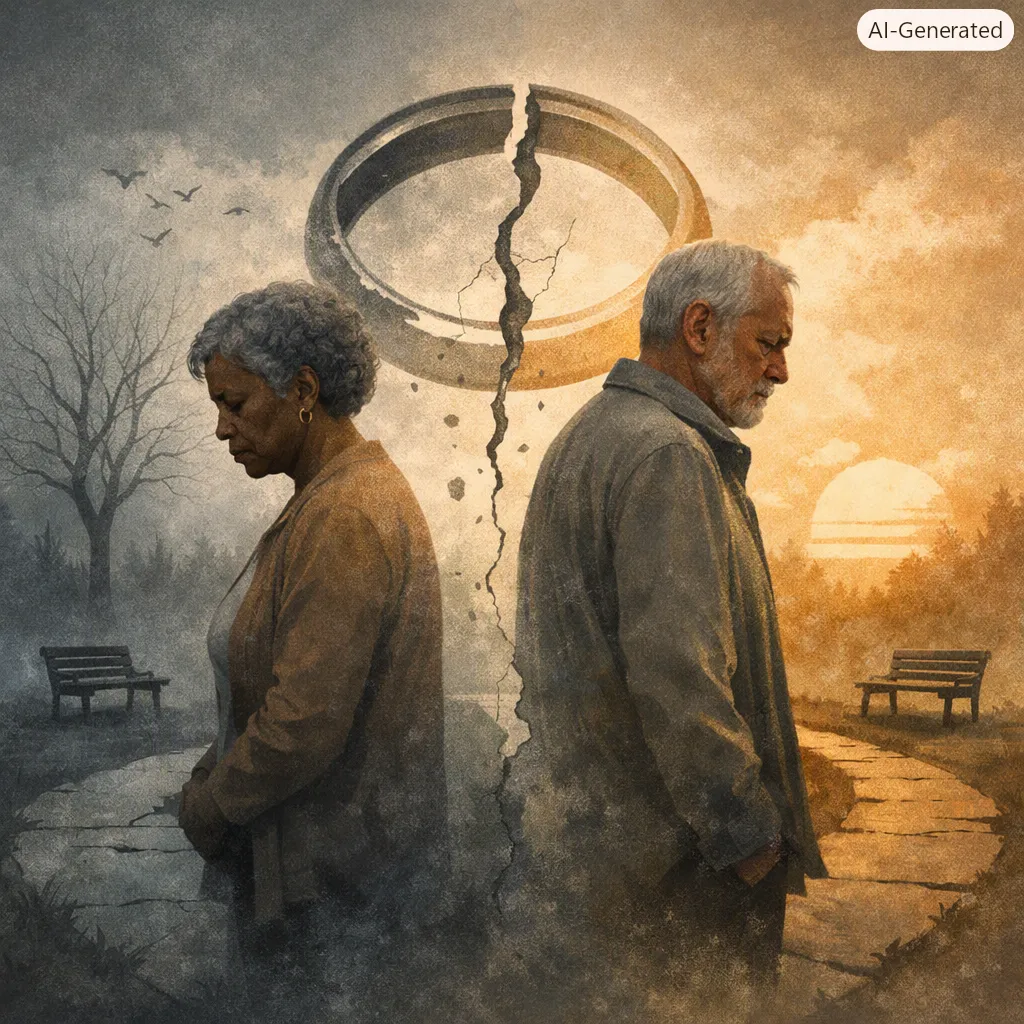
The Kids Are Gone. The House Is Quiet. Don't Let Your Marriage Go Quiet Too.
GRAY DIVORCE
Marriage Restoration Ministry · July 2026 ·6 min. read
You spent twenty-five years building a life together. Raising kids. Paying the mortgage. Showing up to every game, every recital, every 2 a.m. fever.
And now the house is quiet—and instead of relief, there's a knot in your stomach you can't quite explain. You look across the table at the person you've shared a name, a bed, and a life with, and a quiet, terrifying thought creeps in: Who are we now without the kids in the middle?
If that thought has crossed your mind, you're not alone — and you're not too late.
The numbers are real, and they should get your attention
Divorce in America overall has actually fallen to its lowest rate in fifty years. That's the encouraging headline. But underneath it is a harder truth: adults over 50 now account for 36% of all U.S. divorces, and among adults 65 and older, the divorce rate is still climbing—the only age group where it is. Younger couples, on the whole, are getting better at staying together. Longer-married couples are increasingly the ones walking away.
And the cost isn't just emotional. Women over 50 see, on average, a documented 45% decline in their standard of living after a gray divorce. This isn't a clean, low-stakes split. It's often the unraveling of decades of shared assets, history, and identity—at exactly the stage of life meant for rest, not for rebuilding from zero.
Why it happens after the kids leave
Gray divorce rarely starts the day the last child moves out. It starts years earlier, quietly, while the marriage hides behind the busyness of parenting. Here's what's usually really going on:
·The kids became the shared project—and without them in the house, the couple realizes they never rebuilt a shared life of their own
·Retirement removes the routines and titles (provider, coach, chauffeur) that were quietly doing the work identity was supposed to do
·Old wounds—an affair years ago, a betrayal never fully forgiven, resentment never spoken—got shelved for the sake of “the kids,” not actually healed
·Financial disagreements about retirement, spending, and legacy surface with nothing left to distract from them
·Health scares and the visible reality of aging expose how disconnected the marriage has quietly become
None of this means the marriage was a lie for twenty-five years. It means the marriage ran on a shared project instead of a shared covenant—and when the project ended, there was nothing underneath it. That's fixable. But only if you're honest about it now, before the papers are drawn up.
The covenant you made at your wedding didn't come with fine print that ends when the nest empties.
What God actually says about this
Genesis 2:24 doesn't have an expiration date. The two become one flesh — not for the parenting years, not until the kids graduate, but for the whole marriage, including the decades after the house goes quiet.
Ecclesiastes 4:9-12 says two are better than one, because “if either of them falls down, one can help the other up.” That verse was written for exactly this season — the one with more health scares, more loss, more need for someone beside you. Walking away from your marriage right when life requires more partnership, not less, runs directly against the wisdom of that verse.
And Malachi 2:14-15 is remarkably direct: God calls the spouse of your youth your companion, your wife by covenant, and commands, “guard yourself in your spirit, and let none of you be faithless.” That language — “wife of your youth” — is written almost for this exact moment: the temptation, decades in, to walk away from the very person you started with. God's answer is not shame. It's a call to guard what's left and rebuild it, on purpose.
Three steps to take this season seriously
1. Take an honest inventory together — no blame, just truth. Sit down and ask out loud: “What did we stop doing for each other while we were raising the kids?” Let both of you answer without interruption or defensiveness. Naming it is the first act of rebuilding it.
2. Build a shared vision for this next chapter — don't just drift into it. Retirement and the empty nest aren't the end of your story; they're an unwritten chapter. Sit down and actually plan what you want your marriage, not just your finances, to look like in the next ten years.
3. Deal with the old wound you've both been avoiding. If there's an unresolved betrayal, resentment, or hurt that's been shelved “for the kids' sake,” it hasn't healed—it's been waiting. Bring it into the light now, with real help if you need it, rather than letting it surface in a courtroom.
Ask yourself
Did we build a marriage these past two decades, or a really good parenting partnership?
If we retired tomorrow, would I look forward to spending my days with my spouse—or dread it?
Is there a wound between us we've both quietly agreed never to talk about?
Am I more afraid of staying and doing the work, or of starting over at this stage of life?
It's not too late to rebuild
Gray divorce isn't inevitable, and it isn't a verdict on the last twenty-five years. It's a warning light—one you still have time to respond to. The couples who make it through this season aren't the ones who never drifted; they're the ones who got honest before the drift became a decision.
If this article described your marriage, don't just close the tab. Take three minutes for our free Marriage Health Assessment to see exactly where you stand—then book a free Discovery Call. This chapter of your life can be your best one, not your last one together.


